
Keeping LinkedIn, Naukri, Indeed and a portfolio in sync with your CV is tedious and error-prone. An LLM extraction pipeline proposes the changes; a human approves each one.
A dashboard that parses a CV with Claude (or an offline heuristic parser), shows every extracted field as a reviewable change, and pushes approved changes to LinkedIn, Indeed, Naukri, Naukri Gulf, a portfolio repository (as a GitHub pull request) or a custom webhook.
It is an extraction pipeline with a review step, not an autonomous agent: nothing is published without an explicit approval.
The problem
Profiles drift out of date, and an AI that rewrites them unsupervised can invent experience.
The approach
Every value the model extracts is checked against the source CV before it is shown, and every change set needs approval — portfolio publishing has its own separate approval.
What it includes
- CV parsing with ClaudeOffline heuristic parser as a fallback when no key is set.
- Anti-fabrication checksExtracted values must be traceable to the CV text.
- Prompt-injection defenceCV text is treated as untrusted input.
- Review & approveChange sets per destination, approved one by one.
- Portfolio sync via GitHub PRProposes changes as a pull request rather than pushing.
- Browser extensionFills portal forms only when you click, and never presses Save.
- GitHub App install flow, S3 storage, multi-instance RedisPlanned
Role
- Sole developer: pipeline design, safety checks, dashboard, extension and tests.
How it is put together
- CV uploadPDF / DOCX text extraction
- LLM extractionClaude, or offline parser
- VerificationValues checked against source
- Human reviewApprove per change set
- DestinationsPortals, GitHub PR, webhook
- Untrusted-input handling
- Approval before any publish
- Extension never submits
Simplified pipeline.
Related
 In development
Agents · AI · ToolsIn development
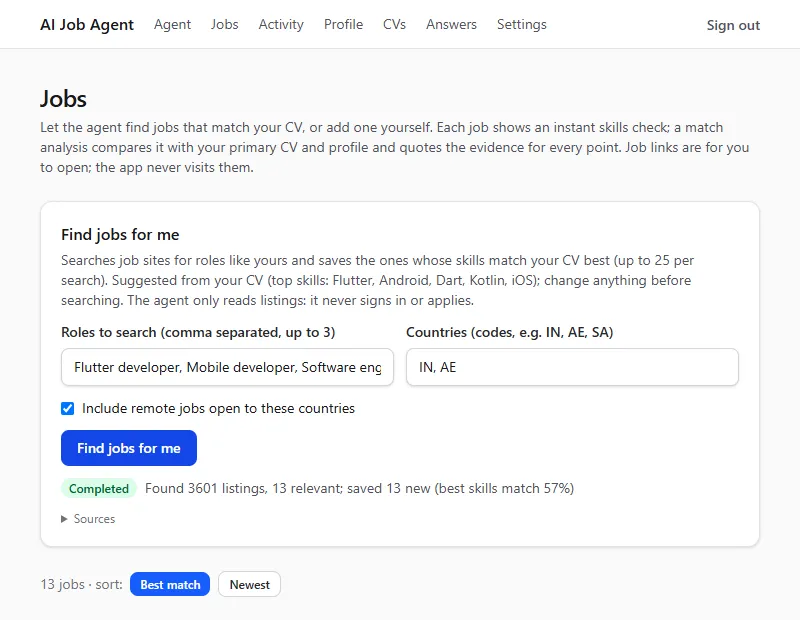
AI Job Agent
A local-first agent that finds jobs, ranks them against your CV and explains every match with quotes. TypeScriptNext.jsNode.js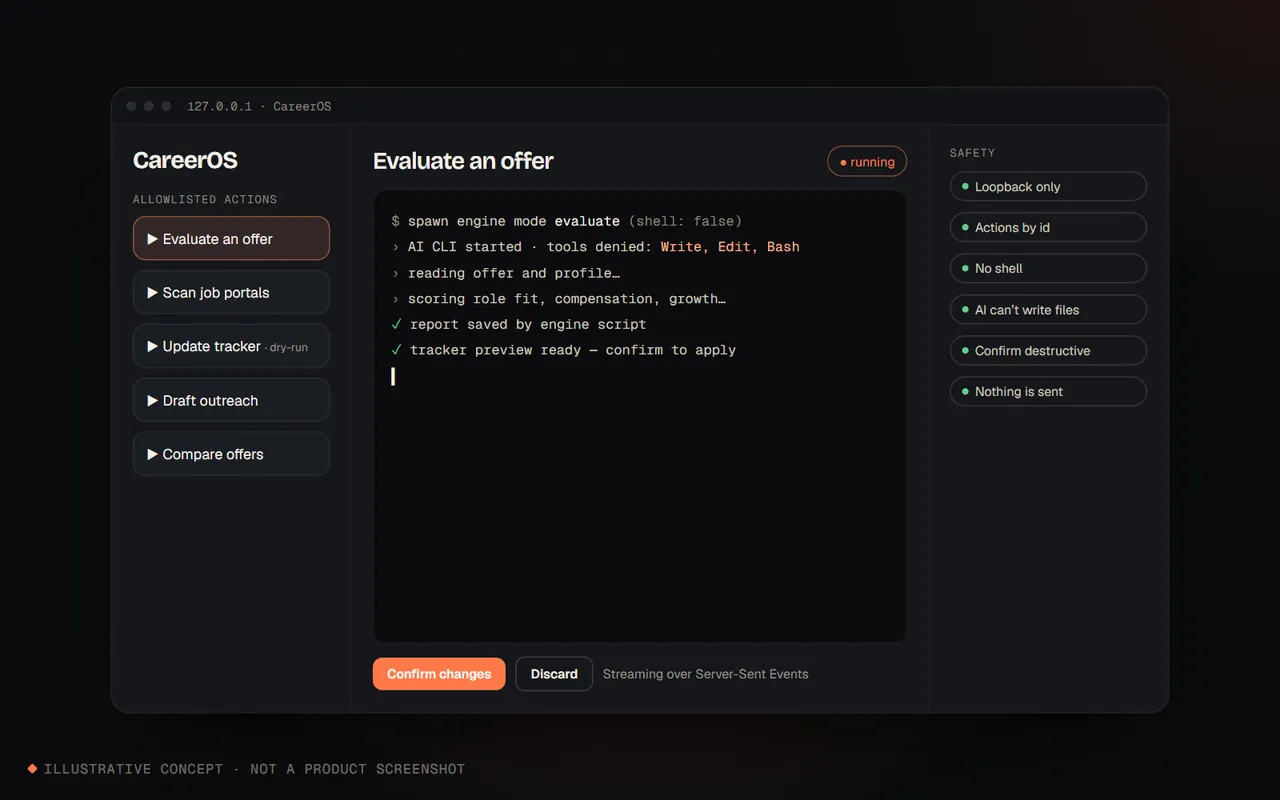 Prototype
Agents · ToolsPrototype
CareerOS
A local command centre that runs an open-source job-search agent’s workflows safely from the browser. ReactViteNode.js Live
SaaS · AILive